Reaching for the Blocks

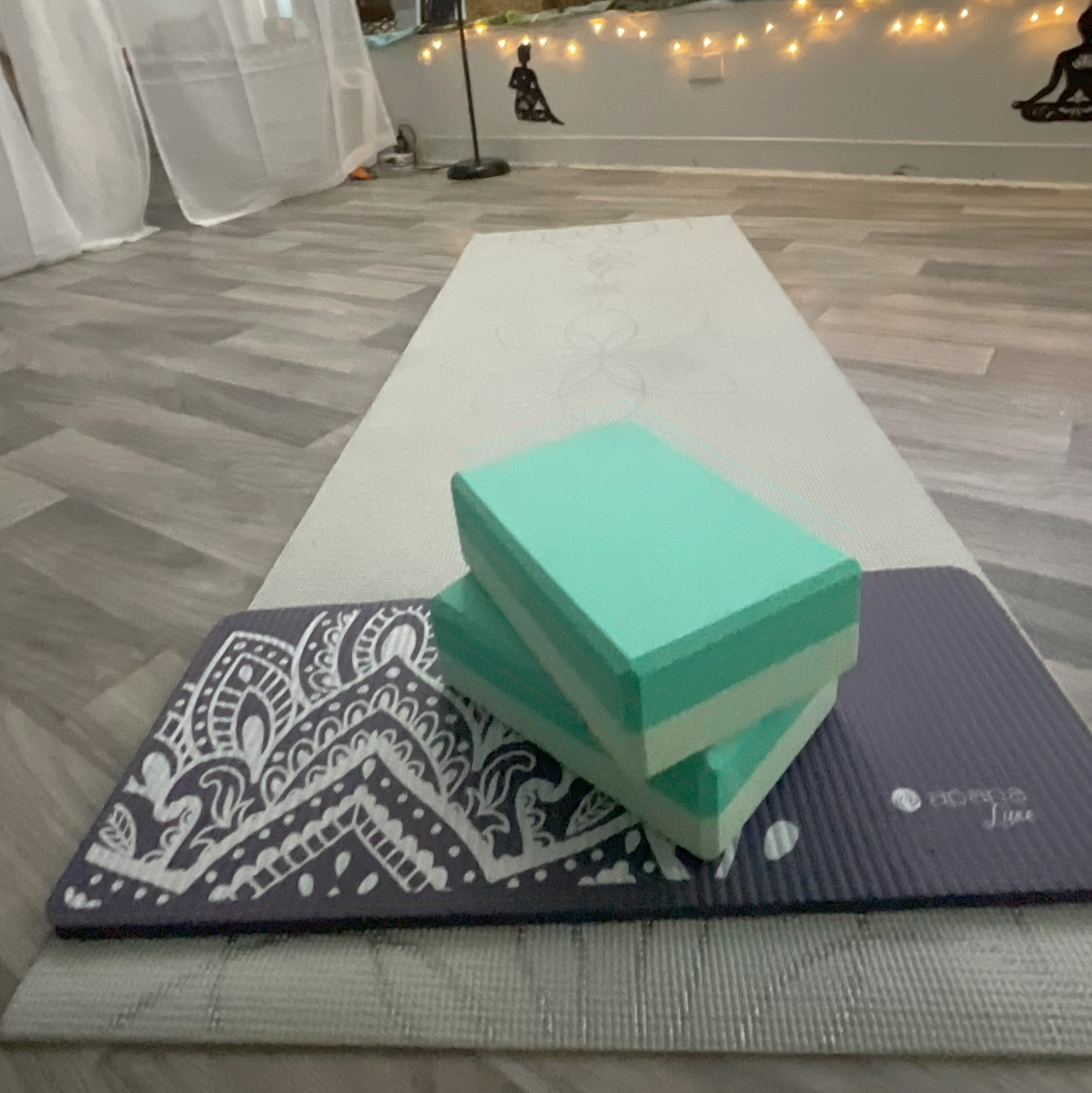
Three lessons from the mat about pain, support, and honoring the body we are in today.
Recently, I pulled a muscle in my lower back and upper hip. Even though my body was clearly asking for rest, I continued pushing through my physical practice.
I told myself I could modify. That movement might help. That I could work around the pain.
But I wasn’t really listening to my body. I
was negotiating with it.
Eventually, the pain became significant enough that I couldn’t see clients. In trying to push through, I had reached a point where my body made the decision for me.
Then on Sunday, I returned to my mat—and my practice felt completely different.
I slowed everything down.
Not because I was trying to get less out of the practice, but because I was finally willing to be fully in it. I moved with intention. I paid attention to the transitions, the pauses, the places where I was bracing, and the places where I could soften.
I locked into my body through my focus and my breath. I reached for the blocks and intentionally created a supported practice for the body I was in today.
I didn’t do every pose the teacher called.
When the class moved into chair pose or yogic squat, I stayed in mountain with my hands at prayer. I centered. I breathed. I allowed myself to be exactly where I was without trying to prove that I could do more.
And physically, it felt so good.
The slower pace was awakening. It brought me into parts of my body I might normally move past. I could feel the practice more clearly—not as something to complete, but as something to experience.
Somehow, doing less made the practice feel more profound.
I wasn’t moving through the sequence on autopilot. I wasn’t focused on keeping up or performing each shape. I was deeply present with my body, my breath, and the choices I was making.
That presence gave me space to recognize how unnecessary it had been to push through pain—and how often we do the same thing away from the mat.
We agree to things we don’t really want to do.
We keep moving because slowing down feels inconvenient.
We dismiss the quiet signals telling us that something isn’t right.
Sometimes the action itself doesn’t seem painful in the moment, but the outcome is. We don’t feel the cost until later—when we are exhausted, resentful, overwhelmed, or no longer able to keep going.
My practice reminded me that support isn’t something we should reach for only after we have pushed ourselves beyond our capacity. Support can be part of how we move through the experience from the beginning.
Three Lessons I’m Carrying Off the Mat
1. Listening is different from negotiating
I knew my body was in pain, but instead of listening, I kept trying to negotiate.
Maybe I could still practice if I avoided certain poses. Maybe the discomfort would improve once I warmed up. Maybe I could keep doing what I normally do if I just moved carefully enough.
Listening asks something different of us. It asks us to receive the message without immediately trying to change it.
Our bodies communicate through sensation, tension, fatigue, ease, resistance, and breath. Listening means allowing that information to matter—even when it disrupts what we planned to do.
2. Support does not make the experience less meaningful
Reaching for blocks did not diminish my practice. Neither did remaining in mountain while others moved into a different pose.
The support allowed me to stay connected to myself.
We can sometimes treat support as evidence that we aren’t capable enough. We tell ourselves we should be able to carry the responsibility, solve the problem, complete the pose, or move through the difficult season on our own.
But support isn’t a failure to do the work. Sometimes, support is what allows us to engage with the work more fully.
3. Slowing down can help us experience more
I completed fewer poses during class, but I felt more deeply connected to my practice.
Because I slowed down, I noticed more. I noticed my breath. I noticed where I was bracing. I noticed the subtle difference between movement that felt supportive and movement that came from habit or expectation.
The slower pace didn’t make the practice less powerful. It made it more intentional. It made it more physical. It awakened my awareness of what was actually happening in my body.
We move quickly through so much of life. We respond before checking in with ourselves. We say yes before asking whether we have the capacity. We complete one thing while already thinking about the next.
Slowing down gives us an opportunity to notice the impact of our choices before we are forced to deal with the outcome.
Three Ways to Practice This for Yourself
1. Pause before automatically saying yes
Before accepting the invitation, adding the appointment, or taking on another responsibility, give yourself a moment.
Take one full breath and ask:
Do I genuinely want to do this?
Do I have the capacity for it right now?
What might saying yes require from me later?
You do not have to wait until you are overwhelmed to protect your energy.
2. Notice where you are pushing through
Choose one area of your life—your body, work, relationships, schedule, or emotional well-being—and gently ask:
Where am I pushing through something that is asking for my attention?
Try to observe the answer without judgment. The purpose isn’t to criticize yourself for missing the signals. It is simply to begin listening now.
Awareness gives you the opportunity to choose differently.
3. Reach for your version of the blocks
Support will not always look like a yoga prop.
It might look like asking for help, moving a deadline, declining an invitation, taking a break, changing your expectations, slowing down, or allowing something to be good enough.
Ask yourself:
What support is available to me right now?
What would help me remain present without abandoning myself?
Then practice reaching for it before you believe you have earned it—and before your body or your life has to demand that you stop.
During the class, reaching for the blocks didn’t make my practice smaller. Slowing down didn’t make it less effective. Both helped me meet myself more honestly.
I practiced with the body I had today—not the body I had last week, the body I wished I had, or the body I thought I was supposed to have.
And I left the mat wondering where else in my life support and slowness might not simply help me endure, but help me experience my life more fully.
Maybe that is part of creating the conditions for healing: listening before we are forced to stop, honoring what is true today, moving with intention, and allowing support to deepen the experience.
Comments